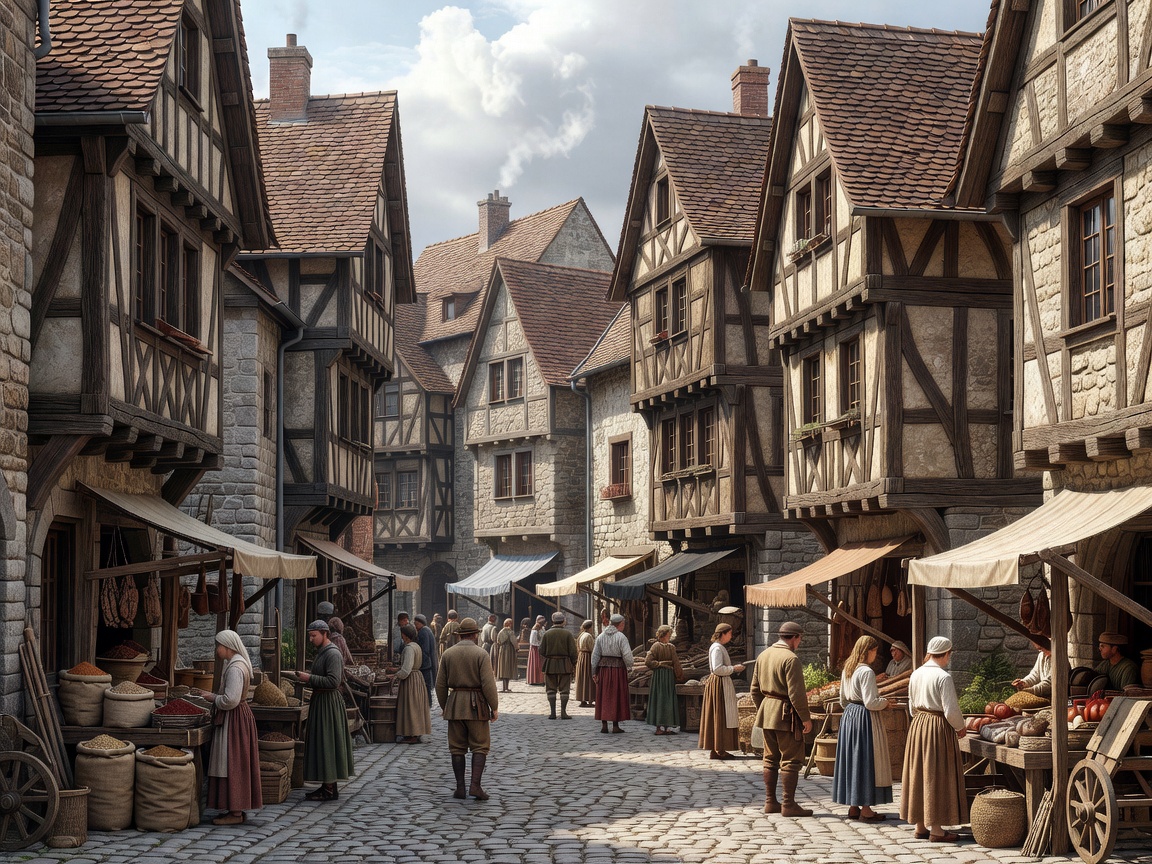
Central Europe: crossings and town privileges
Central European markets often grew around walled towns, river crossings and routes linking agricultural districts with larger urban centres. A visitor may encounter reconstructed stalls for grain, cloth, tools, household vessels and preserved foods. The specific mix depended on local production and the town’s connections.
Historical interpretation should be cautious. A modern event may use a general Central European visual language rather than recreate one documented town. Look for labels explaining sources, period scope and the limits of reconstruction.
Western Europe: ports, fairs and dense urban exchange
Western European market traditions were shaped by coastal trade, navigable rivers and increasingly dense towns. Large fairs could connect merchants over long distances, while ordinary weekly markets served nearby households. Wool, linen, leather, salt, ceramics and metal goods appear frequently in educational displays, but their presence varied by place and period.
Northern Europe and the Baltic
Short growing seasons, maritime routes, forests and fisheries influenced northern market economies. Timber, tar, hides, fish, wax and woven goods can help explain regional exchange, though a display is not proof that every item was traded at every site. Baltic towns also connected inland producers with sea routes, making port geography an important interpretive clue.
Southern Europe: Mediterranean links and local production
Southern markets were affected by maritime exchange, dry farming, vineyards, olive cultivation and dense networks of craft towns. Food demonstrations may feature bread, oil, herbs or preserved produce, but modern recipes should not automatically be described as medieval. Ask whether a demonstration is documented, adapted or simply inspired by historical ingredients.
Eastern and Alpine regions
Eastern European market traditions developed through river corridors, forest zones, pastoral economies and changing political structures. Alpine markets had their own constraints: steep routes, seasonal movement, mountain materials and strategically placed towns. These regions should not be reduced to costume or architecture. Geography explains more than a national label.
How to compare a market
- Identify the stated period and place.
- Note whether the event is a market, fair, festival or reenactment.
- Check which goods, tools and techniques have evidence behind them.
- Compare landscape, transport and local materials.
- Treat broad regional labels as starting points, not conclusions.
Good for
Regional comparison suits visitors who want context before choosing an event, photographers interested in town form, and families who prefer a clear visual route through history.
What to know
Modern events compress centuries into a manageable programme. Their displays can be useful without being complete. Current dates, access conditions and facilities require direct checking with each organiser.
Related guides
Compare event formats · Follow the materials · Plan the visit