Historical markets
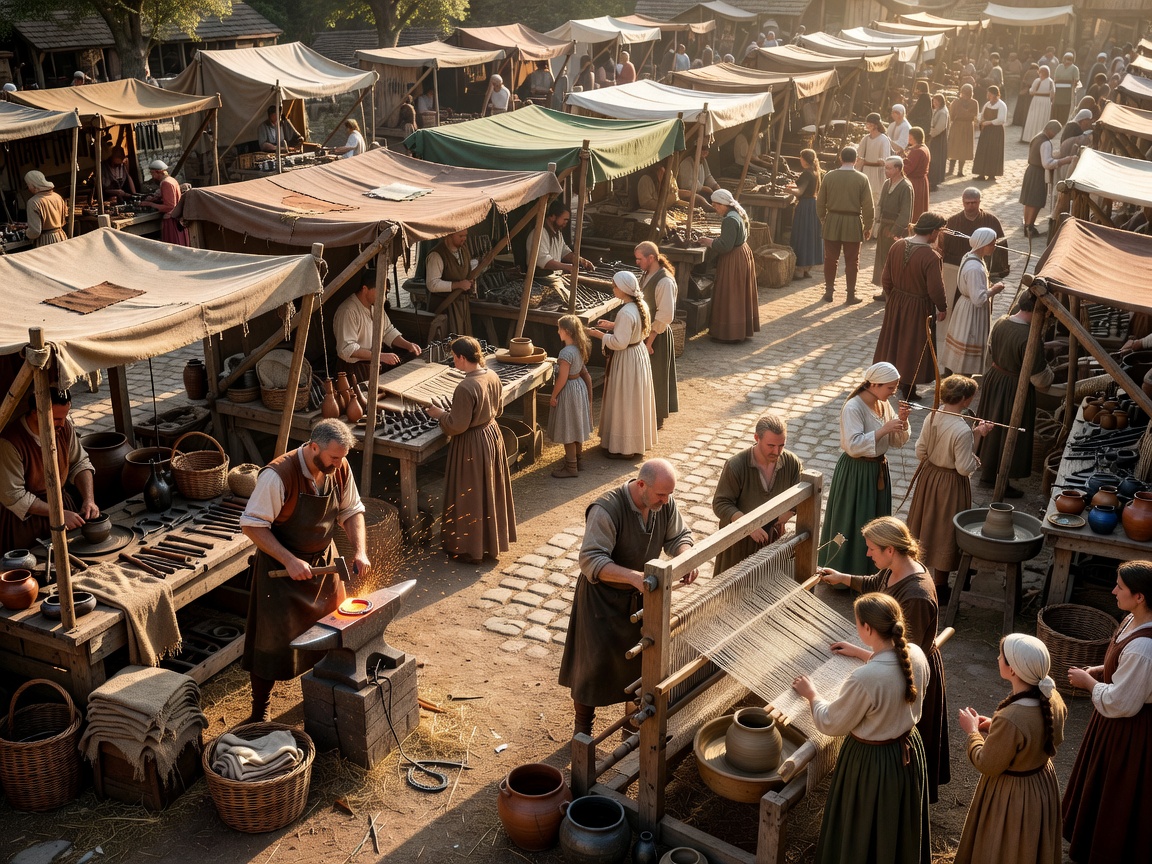
A historical market usually centres on stalls, makers and a period-inspired setting. Some events focus on craft sales and demonstrations; others use historical interpretation as a visual theme. Review the organiser’s description for the stated period, research approach and number of working demonstrations.
Medieval fairs
A fair may be larger and more varied than a market. It can combine vendors, food, music, processions, talks and staged activity. “Fair” is a modern event category here, not proof that the programme reproduces one medieval fair. The educational value depends on labelling and explanation.
Encampments and public reenactments
Encampments present tents, cooking areas, clothing, equipment and daily routines. Public reenactments may add scripted scenes or combat displays. These can help visitors understand spatial organisation and material choices, but performance should not be mistaken for a verbatim historical account.
Demonstration and heritage events
Museums, heritage sites and craft organisations sometimes build a programme around one process: firing pottery, spinning fibre, preparing food or working metal. Such events often provide the clearest explanation because the activity has a defined focus. They may be smaller, quieter and more suitable for close observation.
Food-focused events
Food programmes can explore ingredients, equipment, preservation and serving practice. Recipes may be adapted for modern safety standards or available ingredients. Ask whether the cook is presenting a documented source, a reconstruction or a period-inspired dish. Allergy information and food controls should be checked before travel.
Compare the visitor experience
- Historical accuracy: ranges from source-led interpretation to broad visual inspiration.
- Entertainment: increases with music, spectacle, characters and scripted scenes.
- Scale: larger events offer more variety but can reduce access to demonstrations.
- Audience: some programmes suit families; others target specialist groups.
- Craft content: confirm whether makers work live or only sell finished goods.
Advantages and limitations
Large fairs provide choice and atmosphere. They can also be crowded and historically mixed. Small demonstrations offer detail and conversation but fewer facilities. Museum programmes may have stronger source notes, while commercial events may have broader food and shopping options.
Good for
Choose a market for browsing, a demonstration for process, an encampment for spatial interpretation, and a museum event for structured context.
What to know
Do not rely on assumed schedules, prices or access conditions. Current programmes change. Use the organiser’s current information before booking transport or accommodation.
Related guides
Read the reenactment guide · Study craft demonstrations · Prepare your visit